
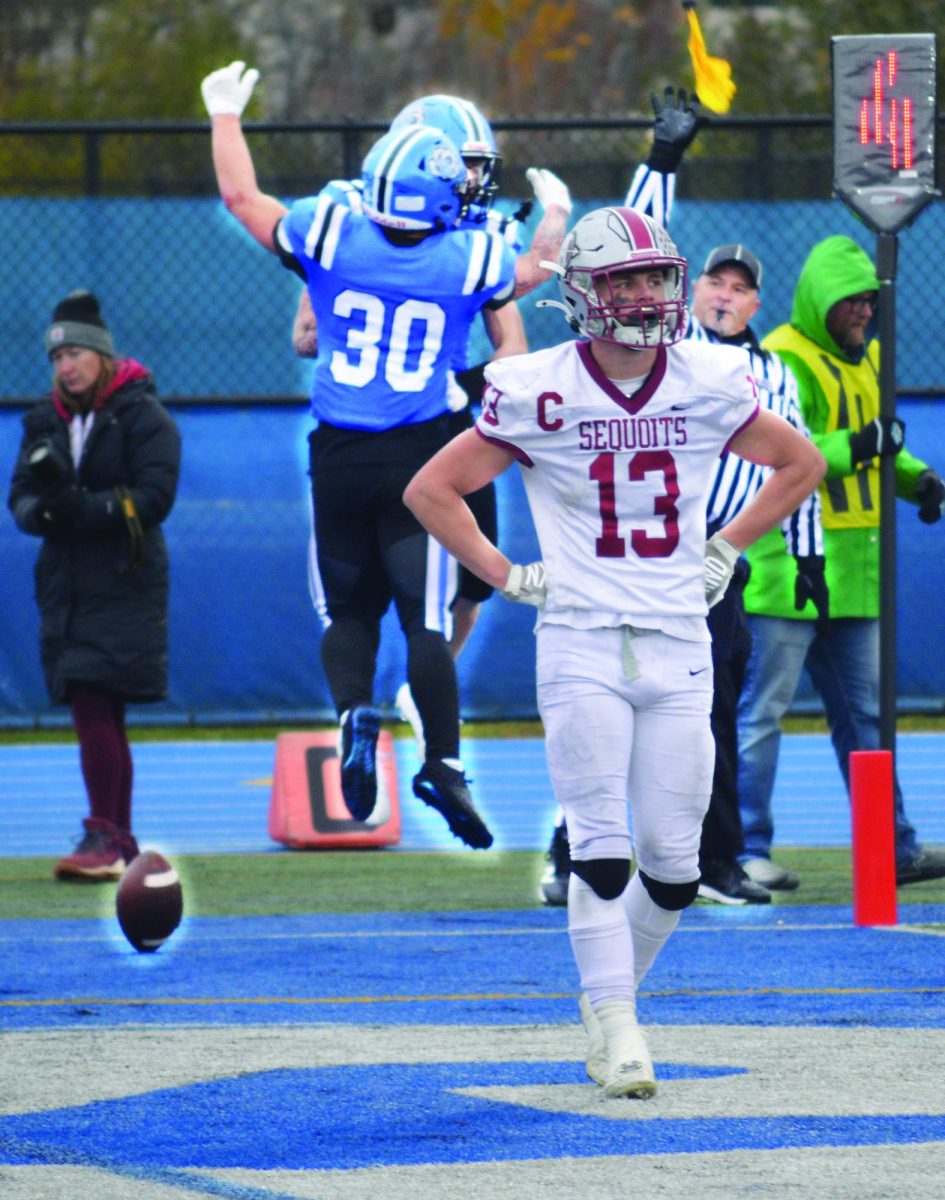
Competition: Competition means to have conflict over limited resources that only one party is able to obtain. As society evolved, competition in the traditional sense of hunter gatherer stopped, and instead turned into sporting events. Ancient Greece had the first ever Olympics during the 770’s BCE. The medieval times in Europe held jousting tournaments. and in the late 1800s, the start of modern sports began in countries such as England in regards to soccer.
As modern sports developed, so did the monetization of these games. Advertisements are more frequent during sporting events. Teams representing their birth nation compete at international competitions, with the teams who win causing celebrations all over their country. As more people watch sports however, the overwhelming issue of how these athletes act on the court comes into the public eye. Some of these athletes love to talk trash, and I personally believe that these inherited acts of bad manners do add a positive impact towards the game. Kaden Abrantes, Senior at LZHS and RB1 on the men’s varsity football team, gives his thoughts on the matter of trash talk.
“I feel that some [athletes] do go too far at times, but there are times where it’s perfectly reasonable. If you do a little dance, as long as it’s not inappropriate, like a high five…I think that’s fine. But if you’re pointing, like yelling at the other team, swearing at them, I think that’s too far,” Abrantes said.
Many different views exist on trash talk in sports from a variety of sources and people of different backgrounds with what they believe should or should not be allowed in competition. Some people justify it as a result of human nature and competition, while others say that being rude and trash talk has no place in sports, regardless of competition.
“Sports is all about teamwork, camaraderie and friendly competition. Bad manners, unsportsmanlike conduct, anything [like that] does not belong [in sports], in my opinion,” Abrantes said.
Abrantes states a talking point of the side against trash talking in sports, but both sides of this argument inherently do have some validity in both of their reasons. Sports in these leagues are broadcasted for entertainment, so it’s understandable that they want their product to have less trash talk during games to be marketable to a wider variety of people. However, people do have a point that players in the media are often praised for their trash talk by fans, with some athlete’s most famous moments being when they trash talk. Brett Stuart, Head Coach at LZHS for Men’s Varsity Volleyball, comments on how energy and environment adds entertainment to sports as much as the competition itself.
“It comes down to if it crosses that line. I think that energy and celebration, that is what makes sports fun. I think when you go into a gym, or outside on a field…you go to an event where it’s just super quiet and you can hear a pin drop, that kind of takes a lot of fun out of the sports,” Stuart said.
What Stuart mentions is a part of a bigger idea about the discussion of sportsmanship and Trash Talk within sports. The idea that sports should have written rules about how players can act against other players in the realm of trash talk and taunting flies directly against what sports is inherently. At least 2 opponents, either in teams or in individuals, go into a match with only one being able win. Is there any respectful way to win? Is there any respective way to lose? If we are going to discuss sportsmanship being a vital role in keeping sports “respectful”, we are disregarding the fact that sports are meant to be competitive. Players are going to lose, somebody eventually has to win. Nobody likes watching someone simply walk straight back into the locker room after a win. Nobody wants to shake hands willingly after a loss. Everyone wishes that they can win the match and go celebrate as loud as they want, flaunting their win. Nobody in life wants to be known as the person who lost.
“Sometimes you get driven more by emotion and you forget your basic fundamentals…you’re just so driven to win that it can lead to playing worse…it’s like a snowball effect,” Hasemeyer said.
Although you can argue that the bad effects of sportsmanship add negative effects to the game, such as players playing “hero ball”, is that not a person trying to play to win? Why are the most watched games, rivalry games? There’s negative emotion and them carrying bad manners and bad emotion for years and generations of players. The match has more “weight” from a viewer perspective because of the bad manners and animosity of teams that were held between players due to a lack of sportsmanship. If we were to analyze how the lack of “sportsmanship” makes a match feel better to watch, look no further than every level of sports. Lake Zurich versus Stevenson is consistently the most attended match by the student body almost every year. College Football has an entire week dedicated to “Rivalry Games,” scheduling games such as Michigan versus Ohio State and Illinois versus Northwestern all in the same week. Division games in the NFL and NBA are given more games in a season as they are considered to be rivals. 54% of the student body likes to watch bad manners occur according to a Bear Facts Survey given in November. So if over half of the next generation of sports fans like watching bad manners, why are players always constantly fined for it? Why do leagues constantly fine players for what they do on the court?
“I have trash talked back at someone, I’m not proud of it, but you can’t just let people step over you,” Abrantes said.
Abrantes says he isn’t proud of trash talking in competition, but why is that? Is it because he felt bad for the words he said in the midst of competition and not wanting to be seen as weak? Or is he afraid of what the punishment would be if he has and says that he is willing to trash talk and likes engaging with it? Sports discussion is all about players rising and falling to the occasion, why can it not be held the same way with trash talk within these sports? Why is something that comes so naturally among competition being looked down upon? Every sport has an example of an athlete that is known for having bad manners, so it isn’t just a “contact sport” phenomenon or any other, it’s tied to how athletics are. People want others to know that they are winning and that they are doing better. People are naturally going to do whatever they can in order to win a competition.
These types of statements represent a crude violation of the spirit of the game, especially when they originate from those who are entrusted with the power to serve as teachers of the game. Although it might seem reasonable to claim that such violations of the spirit of the game might simply result from a lack of awareness of one’s responsibilities as a coach, player, team manager, parent, or else, it illustrates the depth of the challenges stemming from the various misunderstandings of the concept of sportsmanship. (p 79.)
This quote from a philosophical paper published from John Carroll University illustrates the idea that competition and sportsmanship inherently clash against each other in their own ideals. Sportsmanship requires all participants to adhere to the rules of a game in order to guarantee equal enjoyment in the game by all parties. But in a sense of competition, both parties are going to do whatever it takes in order to win, regardless of the enjoyment of the other party. Coaches inherently in their teachings teach athletes to be competitors first, not to show sportsmanship. You’re taught the fundamentals and rules of a sport first before you’re taught a common courtesy of playing. I directly challenge that the spirit of a sport relies on sportsmanship like Nlandu implies. Sure, at younger ages kids are more likely to be courteous to their opponents, but kids are also less mentally developed than their adult competitor counterparts. The spirit of the game is played at the professional level, not the high school level, not at the collegiate level, it’s at the highest level of competition. At the highest level of competition, athletes on the same team are competing for limited roster spots on teams in order to keep working their job, so someone who is trying to secure a living in their job isn’t going to think about how the other person wanting their position feels if they don’t get it. Athletes are focused on one thing as a competitor, being able to stay competing at the highest level of their respective sport.
If professional athletes are supposed to be focused on being a competitor, what do the leagues of these sports do? After all, without an influx of new talent, the sport can quickly die off once that generation of athletes fade out of their prime. This was seen in the Italian Football Federation after the 2006 world cup. Although their roster won the tournament in 2006, they failed to make knockouts in 2010, and failed to even qualify in 2014 and 2018. So if athletes need to make sure that their counterparts don’t overtake their spots, but the leagues want these athletes to be overtaken, what mix can be struck where competition can be stifled enough in order for the leagues to maintain a consistent profit while also being able to keep competition in the league? The answer to that question, as answered by most people, is an athlete’s “marketability.”
It’s undeniable that the marketability of athletes are tied to how much they appeal to a wider audience. When analyzing the many athletes that have had major popularity throughout the years in many sports, a large majority of them have had tendencies to showboat or trash talk. Micheal Jordan during the 1980’s and 1990’s was the star of the NBA, if not sports in general. And his tendency to trash talk, if not as known as the time, did give him more people attached to him in the Chicago area, even if they didn’t follow basketball.
“I think part of it is there’s just a lot more light around it now…you have sports [on] all day, every day. You have social media…you have a heightened awareness of it…So if people say that one of the greatest trash talkers of all time was Micheal Jordan. But when he was playing, there was no social media, there was just less visibility into it before,” Stuart said.
Stuart has described the changing environment of sports and media on the issue of trash talk. The more social media has expanded, the more constant pressure has been on athletes in order to act certain ways, and the ways they act on and off the court get analyzed more and more. As the evolution of sports continues, the one thing that has stayed consistent is that players display bad manners and trash talk in the midst of competition. Players want to assert themselves in the eyes of the consumer as one of the best. If consumers of sports see these players acting like they are the best, on top of playing like they are the best, their marketability increases. However, leagues also don’t want players stepping over lines and boundaries with their trash talk in order to keep their product to be able to be marketed to all intended audiences without censorship, mostly in terms of being family friendly. To combat the issue of these players trash talking, sport organizations institute penalties to specifically combat players showboating or trash talking. These rules often try to censor players’ trash talking habits by soliciting penalties in play, fines outside of play, and match bans in order to keep players’ conduct in line with the idea of someone with “sportsmanship.” But as the media expands around sports, even these rules come under scrutiny of the average fan. Ryan Hasemeyer, Senior at LZHS and RB2 on the men’s varsity football team, gives his thoughts on the rulings around trash talk.
“I think there definitely should be management [of players actions]…but only like a flag or a card should only be pulled when it’s the worst of the worst…you have to let the competitive spirit shine,” Ryan Hasemeyer, Senior at LZHS, said.
Hasemeyer’s opinion about referring is of a wider discussion that is becoming more common in sports discussions. The results of games can be impacted by how the referees impacted the game based on the calls they made. Teams and players constantly get into arguments with the referees about the officiating during the game. Some fans argue that giving the referees the power to dictate how to penalize the way players act during the games as an overstep of the powers of a referee.
“I think they are referred to a little too harshly because it’s part of the fun and the competitive nature [of sports]…if you’re getting paid millions of dollars and you can’t handle watching someone celebrate…I think you have other things to worry about,” Hasemeyer said.
What Hasemeyer refers to is now starting to become a common opinion as more media surfaces of referees making wrong or questionable calls when it comes to player conduct. Some of the most infamous examples are in the NBA when it came to a few cases of All NBA player Jayson Tatum getting technical fouls for clapping. Not saying anything towards the refs, even as the microphones can pick up anything said between them. Not even clapping towards the refs in frustration over a call that he didn’t agree with. He was clearly clapping at himself in frustration when he knew he fouled the player in question, then received a technical foul for his conduct. This wasn’t a one off occasion, it happened twice, at least, both at home and away games. Calls like this frustrate people who want to watch a sport and not a product. Competition and the failure to meet one’s own expectations often leads to frustration. If we aren’t going to allow players to be frustrated at their own jobs and not allow them to show emotion during competition, why not script everything so that the company can make sure everything stays on the script they want. After all, wrestling professionally already does it with the WWE. It’s not like the league doesn’t want these players to stop trash talking and having bad mannered conduct too. In a post on X, the official Philadelphia 76’ers twitter account posted a clip of rookie VJ Edgecombe hanging on the rim after a dunk.
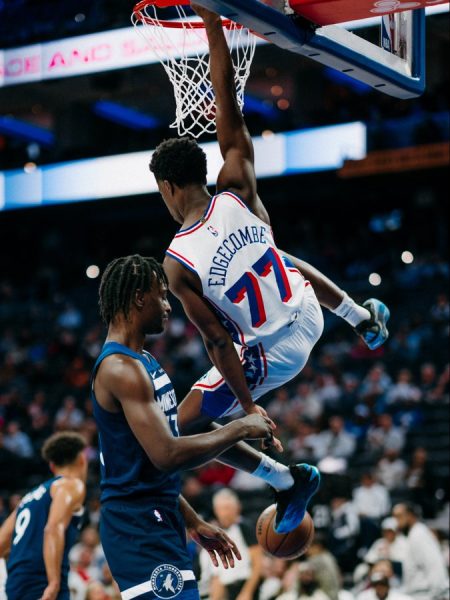
Now, this seems fine normally, until you realize that in the rulebook, technical fouls are given for hanging onto the rim or kicking up their legs. This is only allowed in the NBA rulebook if it is done so to avoid injury to themselves or another player. The photo itself does have another player on the Minnesota Timberwolves in the frame, so it seems as if VJ did this to avoid injuring himself. But the account did give the luxury of fans to the link of the video, which he had many moments to dismount from the rim, but held on anyways. Even though a referee was on the baseline watching him hang from the rim, he still did not receive a technical foul. Even though the NBA rulebooks state that,
“This is an example of a non-unsportsmanlike Technical Foul for hanging on the rim…Players are not allowed to pull themselves up on the rim, nor are they allowed to hang on the rim after a dunk attempt, unless they are doing so to avoid injury to themselves or another player.”
This is a clear and obvious violation and double standards by the NBA and its enforcement of the rules. VJ Edgecombe clearly hangs on the rim longer than needed and, by NBA rules, should have received a technical foul for his conduct. He never received a technical foul for his rim hang, thus showing one example of the double standards of enforcement of its rules. They don’t enforce the rules when it can result in the company making more of a profit off of the bad manners and trash talk players commit. The moment that it doesn’t add dollar signs to a product, instead of being based in sportsmanship, they give out technical fouls. However, every referee trying to keep some sort of sense of true competition within the sport in the game, they have to make that decision based on their own judgement on what they allow and not allow. Concrete rules in the game based on what usually happens can have clear examples and ways to spot when it happens and when the game should be stopped and advantages given when the rules are broken. But, when it comes to player conduct, the referee’s morals and what they consider to cross the line to call a technical foul comes first before any sense of marketability for a greater product.”
To keep the scenario of basketball when it comes to policing player conduct, let’s say that there are so many referees that there is an unlimited, or infinite, amount of referees. Now, these infinite referees are refereeing an infinite amount of games by an infinite amount of players. If the same situation occurs twice, what certainty can be given that the same call will be made twice? Let alone if it happens more than twice, would the “correct” decision be made more times than the wrong one? Would outside factors, such as player ethnicity, player standing in the league, age of the player, and position on the team factor into the call? If player behavior and the line crossed for technical fouls is based on a personal decision by the referee, when can we say for certain that player conduct should be refereed at all?
Now this issue of the calls referees make based on player behavior becomes more complicated the younger and less professional the athletes become. At the collegiate level, the players are way younger than their professional counterparts. This results in a product with way more needing of monitoring of how athletes act on the field with concerns of immaturity from the younger athletes. But at the high school level, most of the athletes are under the age of 18. As a result, the conversation turns from protecting a product towards protecting the students and making sure that there is no altercation on the field as a result of how players act.
“[W]e’re talking about kids, not professional athletes…I think the IHSA and Lake Zurich are fine…we as adults have the illusion of control…we hope that when you have an opportunity to make a right or wrong decision…you make the right decision more times.” Ron Planz, Varsity Men’s Football Coach, said.
As Planz refers to, this debate, at all levels of the sport, is based on a few topics of entertainment, player safety and sportsmanship. Both sides of this debate have equally valid points based on what topic they choose to discuss. Leagues have the right to prioritize player safety and marketability. Fans of the sports want to watch entertaining products and want to have drama and storylines. No side of this argument is inherently correct, but both sides at the same time are also not inherently incorrect, it all depends where the individual stands on the issue.
“I think like anything, there’s a line. Where some of it is good and can help…but I think like anything in our society, we tend to start correctly and then take it too far. So I do think it needs to be monitored and thresholds need to be put in place to keep it civil,” Planz said.
The example earlier illustrates this, every referee can make a call based on what they see happen in the game, and it will have some validity. However, there is usually only one correct answer for referring in terms of player conduct in terms of competition, and that is that it shouldn’t be policed. Players naturally sort themselves out based on who is the best on the field, and who is the worst. Players naturally talk trash the better they are relatively on the field, and worse players tend not to trash talk.. It’s a natural hierarchy that exists in sports. Players also don’t give credit to trash talk if they are winning, as they are ahead in the competition. Players also don’t give credit to someone they consider a worse competitor than them. Keeping competition civil also isn’t what competition is. Competition has a strict winning group and a strict losing group, what is civil about that? What is civil about only 2-6% of high school athletes playing in college based on their sport? There’s limited roster spots in college, so those college players have to keep competing against other college players, including their own teammates, to get into professional leagues. What part about that is civil? There is nothing civil about the pipeline from high school equivalent level competition in sports up to the professional level. If referees are forced to try to keep this civil, how can we be 100% sure that every referee agrees with keeping the game civil in the first place?

The question given to them varied on what sport they were from, but, the question in the questionnaire was given as a player lands a big hit onto another player/ a player hits a shot in another players face, then does a celebration.The initials given are of the head coach of boys’ varsity volleyball, Brett Stuart with a B, Ryan Hasemeyer and Kaden Abrantes, initials A and H, and head coach of the boys’ varsity football team, Ron Planz, with a P. The color red means they do not think the prompt given is enough to establish it as bad manners, yellow means they think it’s bad mannered, but does not warrant to be penalized and green means that it does warrant being considered bad manners and should be penalized. As we can see from a questionnaire that was asked of them before the interview started, from across different sports, the head coaches were complete opposites of each other. The volleyball head coach believes that it isn’t bad manners to celebrate after hitting a “shot” (or told to him as a spike) in another player’s face as long as it isn’t directed towards the other team. Planz, however, says that it is bad mannered, and that they should be given a penalty for celebrating after a big hit, but did say it varied depending on the celebration. However, both Abrantes and Hasemeyer disagreed with their coach that it should be penalized. All these interviews were done separately from each other without the others knowing the questions beforehand. This illustrates the point that competitors understand what they do is bad mannered, but they believe that it shouldn’t be penalized, meaning it’s a part of the game. You can’t separate players’ show boating and trash talking from the competition itself, as players want to be known as the best, and to be known as the best, you usually have to act and play like the best. To use a professional example at the NFL, Lions Wide Receiver Amon-Ra St. Brown was caught on a hot mic after scoring a touchdown, remarking
“I run this **** *****!”
Now you can try to defend the point that this is a one off action done by a singular athlete, not every single athlete does this, right? You would be correct, if he also didn’t say into a camera while playing the San Francisco 49’ers making a whipping motion after scoring a 4 yard TD reception, with 3 other teammates doing the same motions and adding on by saying into the camera.
“What I tell you *****!” and said by another one of the teammates “Whoop that ***** ***!”
These are proof that bad manners comes with sports, no matter how much you try to penalize players, no matter how many deterrents will be set in place by the rulebooks, bad manners is intertwined with competition, whether you like it or not. All celebrations, even done with the team with no intention to be bad mannered, can be viewed as a taunt to the other team, after all, you’re celebrating either winning over them or over capitalizing on their mistake. To pose one final thought, think about this. Is a player, by performing acts of bad manners displayed by players such as Amon-Ra St. Brown, intentionally doing so in a bad mannered way, or are they doing it as a result of the competition itself?
“I feel like it’s not more of the competition, it’s more on the player’s emotions…you’re going to see me yelling, screaming, hyping myself up, so I feel like it’s fine,” Abrantes said.
“I think competition leads people to show off bad manners,” Hasemeyer said.
“I think that as a natural reaction as human beings, who are competitive…to act in those bad manners or unsportsmanlike ways in the heat of competition is natural,” Planz said.
https://videorulebook.nba.com/archive/technical-foul-player-hangs-on-rim-following-dunk/
https://x.com/sixers/status/1979330500847350173
https://collected.jcu.edu/cgi/viewcontent.cgi?article=1001&context=phil-facpub