
The college recruiting process is often portrayed as exciting. Excitement is brewed through a variety of offers, visits, and the promise of playing at the next level. But behind this commitment and excitement can be a different kind of reality. There are many mental side effects like constant evaluation, pressure to perform, and the feeling that one wrong move could make everything disappear. For many high school athletes, recruiting does not just shape their future in sports but it also shapes their confidence and mental health.
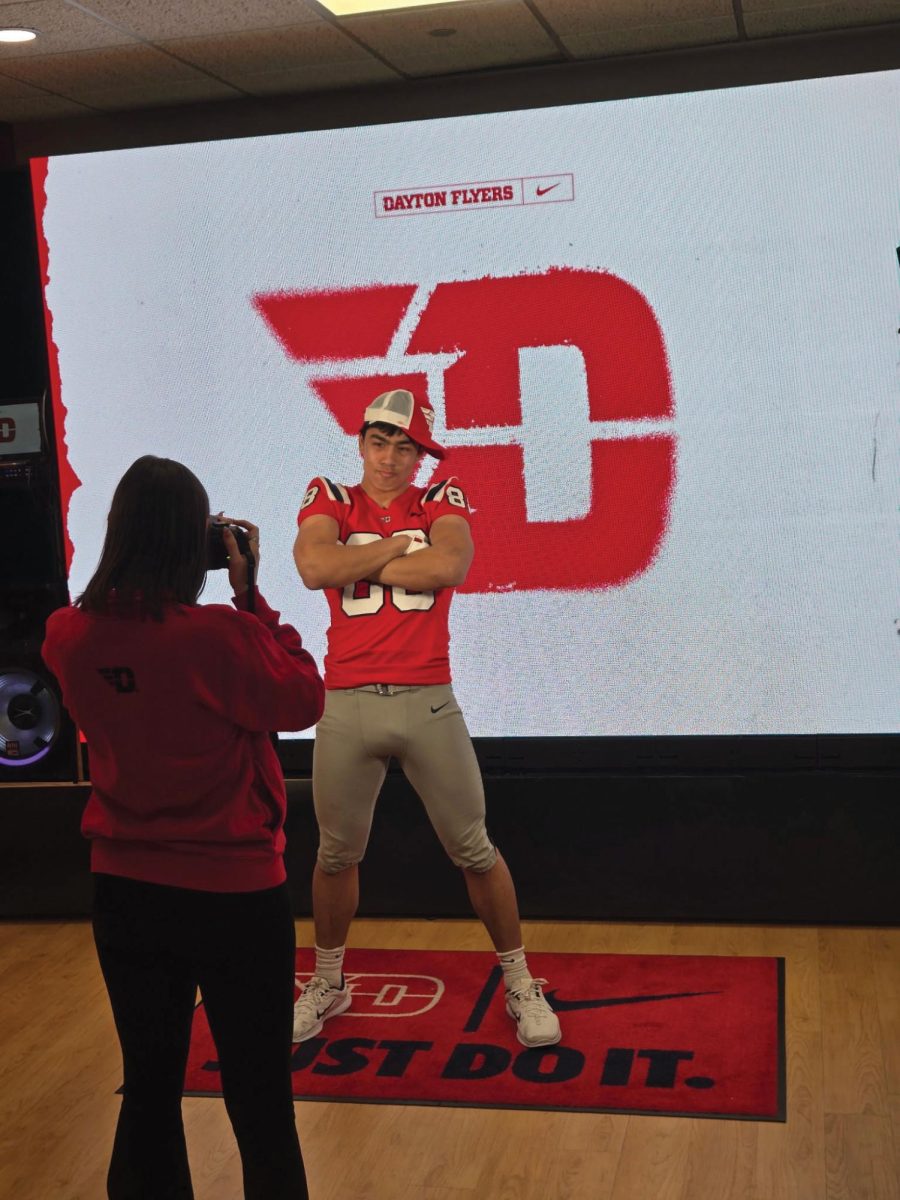
For Chris Chang, a football player committed to University of Dayton, the recruitment journey has been more about navigating his uncertainty in it all rather than celebrating the success.
“It is very stressful, because you are constantly trying to decide where you are trying to go,” Chang said. “They are kind of just leading you on, almost like showing interest, but you are not sure if they are going to show enough interest to allow you to play there.”
On the other hand, Nick Gast, a track athlete committed to Miami University in Ohio, feels that the effects of recruiting weigh more on the beneficial side rather than the negative.
“It has brought me a lot of happiness and a lot of people congratulate me and it just makes me happy to see the results like that,” Gast said. “I think the program [I am going into] will be comforting, and it knows that people have bad races and it won’t [put stress on me] if I ran a bad race.”
From the outside, coaches often seem to hold all the control. According to Terry Coughlin, the Lake Zurich High School men’s varsity basketball coach who has worked closely with recruiting, reveals that the biggest burden of recruiting can be the one that athletes undergo internally.
“There can be pressure that athletes put on themselves to try to get to that next level, and so that is when the pressure exceeds kind of the pleasure of the process of getting better and playing,” Coughlin said. “When I see that part, that is when I start seeing some of the anxiety and stress kind of creep in for the athletes.”
While some athletes are already committed, others are still hoping they will be noticed. Although, the question still arises whether the ones looking to be recruited know of the drawbacks that come with. Still looking to be recruited in her future, Arisa Bisofa, sophomore, elaborates on her knowledge of the hardships that may come with college recruiting.
“I always feel like I have to always be perfect, but it is not always gonna be perfect. I put in so much effort, and when I am at meets, I am so ready to do good, but when I do not perform as well as I want to, it gets frustrating and I feel like I am letting people down,” Bisofa said. “I also feel like if I get injured, my whole [pathway will be] ruined, which is terrifying. I have seen people get their scholarships taken away, which is scary.”

Chang shares this fear of a ruined pathway, highlighting that although the pressure comes from the feeling of being watched by scouts, it can also come from within him.
“Sometimes you might be expected to go play at the next level, but a lot of that pressure is put on by the athletes themselves. I feel like I put a lot of pressure on myself to go play sports in college. So sometimes when a college does not respond, or maybe I have a bad game, I just believe less in myself afterwards,” Chang said.
However, exposure to a higher level of competition and pressure may also have the opposite effect than stated earlier, validating the potential of an athlete rather than taking it away.

“I think definitely [your confidence gets] boosted a lot because it shows you how you are at the top, and then you gain a lot of confidence at the high school meets, because after meeting all these college athletes, you realize that you are on a good pathway towards the future,” Gast said.
Although Gast found confidence through comparison, Chang found that the process may create possible disharmony between individual performance and team connection.
“Having bad stats [after games] becomes a conflict,” Chang said. “Do I care more about myself and my recruiting status or the team? And so you are constantly battling those values.”
Coughlin acknowledges this imbalance and shares some strategies athletes can use to fight back against these drawbacks to keep their mental health in complete check.
“[My advice is to] try to remember why you played the game in the first place. Try to play with the joy and the passion that you probably played with when you were in second, third, fourth, fifth grade,” Coughlin said. “Still remember that it is a game that you get to play with your buddies and go in there and try to treat each day with kind of that same passion and joy. Usually when you are happy and you are playing with that joy and that pride, that is when you play at your best.”