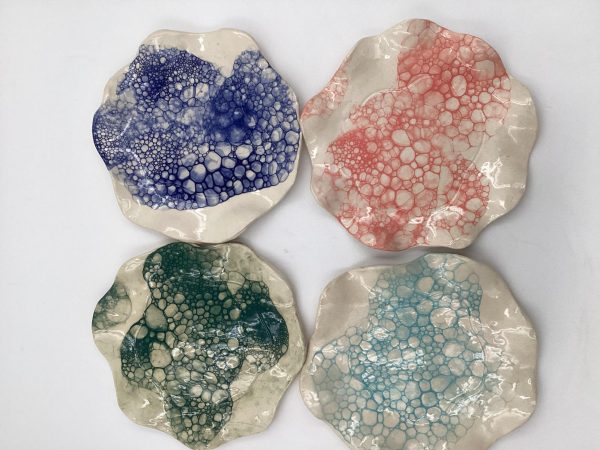
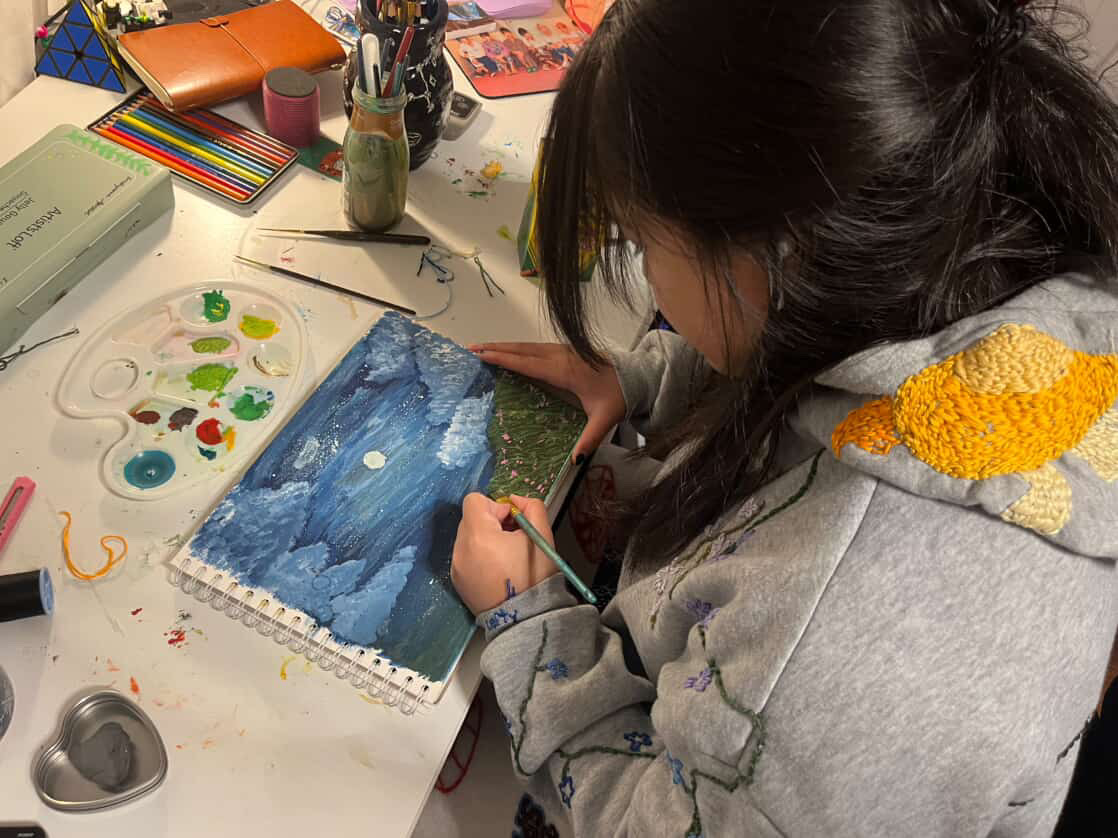
Paintings, portraits and photographs line the C hallways, titled with students’ names, representing their skills built since elementary school. A glance into the neighboring art classrooms shows students working on their projects, usually a bustling, lively sight. Stopping to view the art brings a sense of imagination — a reminder of the creativity from both current and graduated students.
This is credited to the Art Education department at the school, currently composed of Gillian Teichman and Kristen LaJuenesse. Even though the Art + Design department is not an entirely independent cluster within the school, being a part of the Innovation & Career Pathways department as headed by Nicole Jensen, the two teachers still operate independently from many others.
“I am teaching painting and drawing,” Teichman, Art + Design teacher, said, “– so drawing basics and still lifes. [We are] drawing comic books right now. [In] painting, [we are] working with different mediums. Right now, [we are] doing gouache, [and moving] into acrylic soon.”
Even with the set curriculum, art classes end up being comparatively self-paced and independent. Since art as a topic is connected to the individual through self-expression, students are able to choose which mediums they enjoy the most and enroll in the classes that they think they will get the most out of. This all contributes to a largely personalized environment in the long run — each student excels in their own way, on their own.
According to a November Bear Facts Student Media Survey of 220 responses, Painting, Drawing, Photography, and Ceramics are the most popular art classes, with 5.6%, 10.7%, 10.2%, and 16.5% of students taking them or have taken them respectively. LaJuenesse teaches Ceramics, and Teichman teaches Painting, Drawing and Photography. All of these are generally considered to be freshman and sophomore-level classes; they act as a gateway to the rest of the art classes that are accessible to upperclassmen exclusively.
“Maybe, you touch a little bit on digital drawing, and then you really want to keep doing that. We [do not] really have a digital drawing class, but if you want to keep doing it, you can do it in your Studio Honors and up into AP,” Teichman said.
Loose class structure, such as in the Art + Design department, will not necessarily meet every student’s needs. Some students prefer to have more rigid and firm methods of instruction. Guidance in these classes certainly exists through gradesheets and units and subtopics; still, most students remember a chill and relaxed environment that they do not see in core classes.
Students who do not like the academic environment at all and want a much less committed space can join Art Club, newly sponsored by Teichman and in session every other Wednesday after school. Of the students responding to that same Bear Facts Student Media Survey, 6.4% of students are enrolled in LZHS’s Art Club.
“I enjoyed glazing in ceramics; even if the colors [were not] always exact, the process was pleasant,” one anonymous survey respondent said. “The art classes [I have] taken have helped me connect with like-minded people and explore the potential of my creativity. Also, I love being able to make art in general,” another said.
Earlier in the year, Teichman won the Early Art Educator of the Year Award, as announced at this year’s homecoming assembly in September.
“Every teacher is going to teach the same class differently,” Teichman said, “so the things that I will teach will just be new in general, just because [I run] new projects and everything. So [I will] see what is sticking, what people really like doing, and then maybe further investigate that.”
A ‘bad’ art teacher can make or break each student’s personal relationship with art. However, at LZHS, both art teachers are met with grace and praise from past and current students.
“The current teacher (Ms. Teichman) that I have is very flexible, which is pretty nice since I keep on getting ahead of myself for assignments,” an anonymous survey respondent said. “Laj is a great teacher [and I] love how she teaches,” another said. “Teichman is an amazing art teacher, I am grateful that she is a teacher here,” another said.
Because the Art + Design classes are elective classes and do not contribute to any of the graduation requirements, enrollment is entirely optional. This ensures a proactive learning environment because the people taking the art classes all chose to be there; this means that students are always ready to learn and engage with that day’s activities.
In the end, art will always be about the individual. Even without any teacher guidance at all, people will always find a way to express themselves and be creative. Plenty of students participate in art outside of school – all the art department really does is foster and bring out the creativity inherent within students, that they feel every day.
“I love making art pieces about controversial topics. I feel like [it is] a good way to encourage people to discuss important societal issues,” an anonymous survey respondent said. “I get to be creative [in class] and I love making art,” another said. “We had a lot of opportunities to make new pieces in ceramics,” another said.
Art is a very healthy activity for the mind. Self-expression is incredibly important for both mental wellbeing and well-rounded development for all students. According to a 2018 Americans for the Arts poll, 91% of Americans believe that the arts are vital to a well-rounded K-12 education. At District 95, art education begins in elementary school and continues throughout. Many schools with less funding cannot provide Art + Design classes, so the ones LZ has are met with gratitude.
“The program is still very strong,” Teichman said, “as it always has been. [We are] just ever-growing, and [we are] figuring out where we want to go and where [we are] at right now. I [would not] say there are gaps [in the program]; I think [we are] at a good spot.”