Teens need to form own opinions, make own decisions
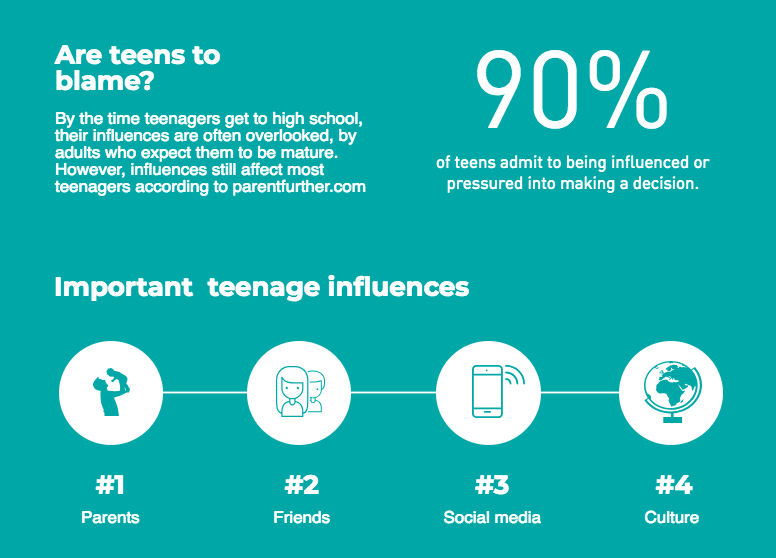
Teens these days are too easily persuaded, whether it be forming political ideas or deciding to try something we may not want to, we walk blindly into decisions based on what we hear from other sources around us rather than think for ourselves.
Although teen decision making isn’t as good as an adults, there is a reason for this. Compared to the adult brain, which thinks more rationally, the teen brain is very underdeveloped. The part of the brain which controls the teenage mind is called the amygdala, an almond shaped part of the brain that controls decision making.
“The brain is mostly developing during the teenage years,” Chhavria Abria, neurologist, said. “Usually the human brain is not fully developed until we reach the age of 25.”
With underdeveloped brains, we are also much more impressionable than adults, meaning we are more apt to make a decision blindly from outside influences, than from what we actually know.
“The structure of the brain is almost like a computer with different circuits and connections. Decisions are made with the connections from one part of the brain to the other, and an underdeveloped teen brain lacks these connections, so the information can’t be processed,” Abria said. “Because of this, teens react on the influences around them, such as mood or other people.”
Despite this setback, there is nothing that says teens are unable to slow down for a second and try and think a bit more rationally. We must learn take a second and let our brains process information, as opposed to rushing and making a blind opinion or decision.
For example, many high school students for blind opinions about politics and come to class with certain political views that represent their parents, and then once they go off to college and become more knowledgeable about politics, their political views completely change.
Rushing into decisions or opinions blindly only can lead to negative consequences. Teenagers need to take the time to educate themselves and form their own opinions about certain topics, as well as take time to make rational decisions.
Young adults, teens need to get more involved in politics
Americans who do not vote are idiots. Literally. The word idiot originates from the Greek word idiotes, which referred to citizens who did not vote or were not involved in public life.
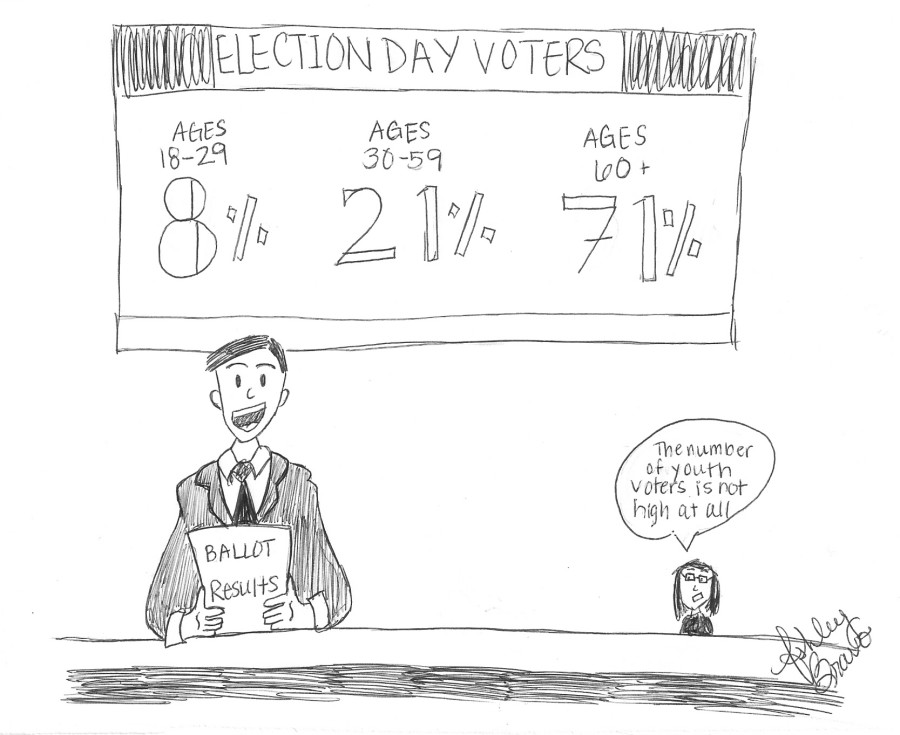
Today’s society should have a similar view of non-voters, who, statistics show, are mostly young adults. Young voters should be more involved in politics because they need to support their beliefs in elections. They will be more content with government decisions if they exercise their right to vote.
In the 2010 election, voter turnout for people over the age of 65 increased 16 percent. In contrast, voter turnout for youth decreased 55 percent, according to Project Vote’s website, dedicated to election and voting information.
Americans, especially young voters, need to go to the polls and vote for what they believe in. If young people do not cast their vote, their opinions and their political party’s opinions will get overlooked and disregarded. If young people want change, they need to vote for it, as the majority of older people are currently doing.
“I’d say [older people vote more] because you start to understand politics a little better. You see how it directly relates to every aspect of your life, your paycheck, your taxes,” Chris Lagioia, government teacher, said. “It kind of hits you more as you get older; you own a home and pay a mortgage, there are things you want to purchase, and you see how the laws affect you more and more.”
Although older people have more experiences relating to how the government affects them, younger people should be more involved in politics and care about what happens at the elections, too. Everyone in this country is affected by the government and the decisions it makes. Everyone should want to have a hand in deciding who will be making the decisions.
The overall voter turnout was at an all-time low for the 2010 election: 66 percent of eligible voters did not vote at all. One possible explanation for this is that the election was an “off-year election,” one that does not include a presidential election, according to Project Vote’s website.
“A lot of times there are difficult elections to vote in – they might not like either candidate – but I think it’s better to vote and have an opinion in a democracy versus not voting at all and then complaining about the decisions that the government makes later,” Lagioia said.
If young people do not vote, they will continue to complain about how the country is being run without actually doing anything about their disapproval. People would feel that their voices are being heard if they voted. People who vote can help support their beliefs through candidates’ platforms.
Although there are possible explanations for the 2010 voter turnout, the statistics for the 2008 presidential election show similar facts about voter turnout for the younger age group.
Voters ages 18-29 make up 21 percent of the eligible voting population, but in the 2008 presidential election, they made up only 17 percent of the actual voting population. Also, less than half, 49 percent, of 18 year olds are registered to vote, according to Project Vote’s website.
The initiative toward wide-spread voting starts with high-school students. Students who are approaching the voting age should tune in to political current events to get informed. Government decisions affect all people, no matter if they are of voting age or not. Also, sooner or later, all students will be of voting age, and then it is their duty to vote.
In the long run, the goal is for more of the populous to actually vote, but at the same time the voters should be making informed and intelligent choices.
“I think ultimately, regardless of age, we want to see people who are informed [and have] done their research, make an educated vote. I think the key is younger or older, they should be voting, but do the research and try to vote as an educated citizen,” Lagioia said. “The person needs to do their research, they need to find out the political stances of the candidates on multiple issues, and use multiple sources.”
Non-voters of all ages have no right to complain about how the country is being run because they have the right to vote, but it’s up to them to exercise their right. Involvement in politics is a must for citizens who want to be content with their life and country.
Students prove tolerant of others
December 13, 2010 by News Editor
Filed under News
Although 87.4 percent of LZHS students are Caucasian, almost all students said they are tolerant of people from a different race, according to a recent Bear Facts survey.
Bear Facts conducted a survey of over 300 students to question how tolerant students were with people of different races, religions, social groups, and sexual orientations. The survey findings suggest males were least tolerant of sexual orientation and social group, but most tolerant of race. Females showed to be least tolerant of social group but most tolerant of race.
“I think most of our kids are respectful to one another in those [categories],” Bryan Stortz, dean, said. “It seems that most of their differences stem from just dislike,” like one boy stealing another’s girlfriend, or one giving another a ‘look’ in the hallway.
Stortz claimed that only once or twice a year do students get into fights because of race, religion, or status.
“I wouldn’t say we’re 100 percent tolerant, but I think most kids actually are,” Stortz said.
According to the Bear Facts survey, however, males were least tolerant of others because of their sexual orientation, not because of dislike. The survey also showed females were least tolerant of others because of their social group or clique was different than the one they identify themselves as.
Although 9 percent of students surveyed said they were least tolerant of race, Samantha Lacsam, junior, said race doesn’t make a difference to her.
“I don’t think it’s my position to judge anyone for anything they believe in or do,” Lacsam said. “I can’t see anybody judging someone for something like [race].”
Lacsam says her friends don’t care what backgrounds their friends have either.
“I’m, like, the only Asian I hang out with,” Lacsam said. “And I don’t even feel like they’re treating me different. Race doesn’t even come to mind with us.”
Only 6 of the over 300 male and female students surveyed said they were intolerant of students in all the categories of race, religion, social group, and sexual orientation. Yet 150 students said they are tolerant of all the categories.
“I would think we’re tolerant of other people because we have been educated on respect and taught our differences make us unique,” Stortz said. “But that doesn’t mean we can’t make someone we’re different than, someone we work with, or are friends with.”